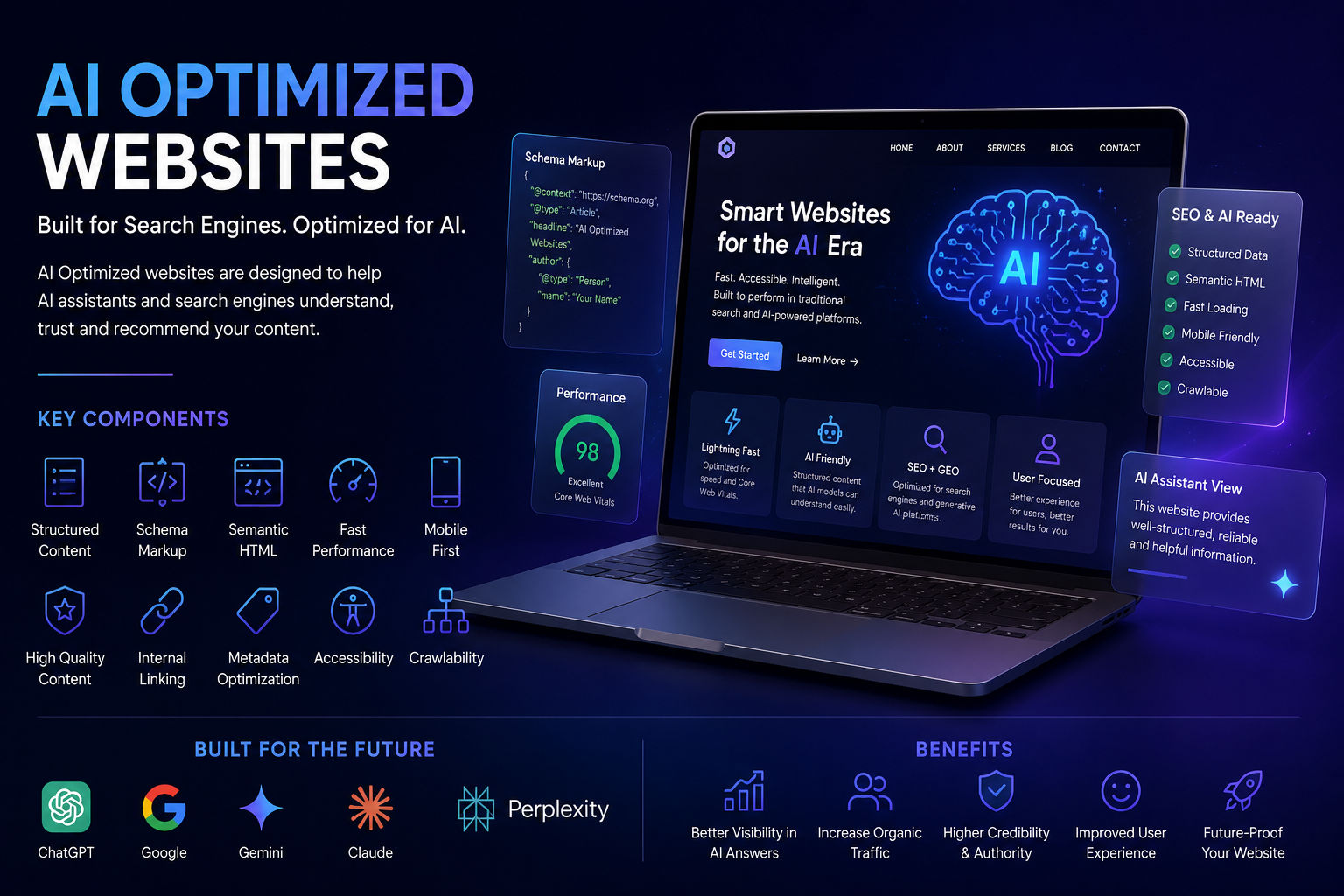
AI-Optimized Websites: Revolutionizing Modern Web Development with Artificial Intelligence
Published: July 2026 Category: Artificial Intelligence • Web Development • Next.js
Introduction to the Era of Intelligent Websites
The internet is undergoing a significant transformation, where websites are evolving from static collections of pages to dynamic, intelligent systems. These modern websites can comprehend user behavior, automate operations, optimize performance, and make decisions without constant human intervention, thereby redefining the user experience.
An AI-Optimized Website embodies a holistic integration of Artificial Intelligence (AI) into every facet of the platform. It's not merely about incorporating ChatGPT or an AI chatbot; rather, AI serves as the central nervous system, overseeing traffic management, content personalization, search engine optimization (SEO), security threat detection, customer support automation, and continuous user experience enhancement.
Businesses that adopt AI today are at the forefront of creating websites that are not only faster and smarter but also more scalable and efficient than traditional web applications. This shift towards AI-Optimized Websites marks a significant milestone in web development, promising to revolutionize how we interact with and experience the internet.
Defining AI-Optimized Websites
An AI-Optimized Website is characterized by the seamless integration of Artificial Intelligence into multiple layers of the application, including:
- Frontend Experience: Personalizing the user interface and experience.
- Backend Operations: Automating server management, database optimization, and performance monitoring.
- Database Optimization: Ensuring data efficiency and security.
- Performance Monitoring: Continuously assessing and improving website speed and responsiveness.
- Security: Detecting and mitigating potential threats and vulnerabilities.
- Marketing: Tailoring content and campaigns to specific user segments.
- SEO: Enhancing visibility and ranking on search engines.
- Analytics: Providing insights into user behavior and website performance.
- Customer Support: Offering personalized assistance and resolving queries efficiently.
By leveraging AI, these websites can learn from user behavior and automatically improve their performance, thereby offering a more dynamic and responsive user experience.
AI as the Website Manager: Efficiency and Innovation
Envisioning AI as a diligent, around-the-clock digital employee revolutionizes the concept of website management. Beyond merely answering customer inquiries, AI can oversee the entire website ecosystem, monitoring performance, identifying issues, analyzing visitor behavior, and providing insightful recommendations for improvement.
Examples of AI's managerial capabilities include:
- Traffic Analysis: Predicting and handling unusual traffic spikes.
- Security Enhancement: Blocking suspicious requests and predicting server overload.
- Performance Optimization: Optimizing image delivery, managing cache efficiently, and suggesting better product placement.
- Content Personalization: Recommending personalized content and generating product descriptions.
- SEO Automation: Improving SEO rankings automatically.
This comprehensive management allows developers to focus on feature development and innovation, while AI handles the repetitive and operational tasks, ensuring the website remains efficient, secure, and user-friendly.
Intelligent Traffic Handling: Scalability and Performance
One of the significant challenges modern websites face is handling sudden increases in traffic. Traditional websites often rely on fixed scaling rules, which can be inadequate during unexpected surges. In contrast, AI-powered infrastructure predicts traffic demands before they become critical issues, ensuring the website remains responsive and performant.
AI continuously monitors key performance indicators such as:
- CPU usage
- Memory consumption
- Database response time
- API latency
- Network bandwidth
- Active users
- Geographic traffic distribution
When demand increases, AI can dynamically:
- Scale servers automatically
- Enable intelligent caching
- Balance requests across regions
- Prioritize critical API calls
- Reduce unnecessary processing
This proactive approach ensures that websites maintain their speed and responsiveness, even during high-demand events like product launches or festival sales, thereby enhancing user experience and satisfaction.
AI-Based Performance Optimization: Speed and Efficiency
Performance is a critical factor for both user experience and search engine rankings. AI continuously analyzes various aspects of website performance, including:
- Slow pages
- Heavy JavaScript bundles
- Large images
- Long API requests
- Core Web Vitals
- Rendering bottlenecks
Based on these insights, AI can recommend or automate optimizations such as:
- Image compression
- Lazy loading
- Code splitting
- CDN optimization
- Cache strategies
- Database indexing
By identifying and addressing performance issues in real-time, AI ensures that the website operates at optimal levels, providing a seamless and efficient user experience.
Personalized User Experience: Engagement and Conversion
Every visitor to a website is unique, with their own preferences, interests, and behaviors. AI creates personalized experiences by understanding and adapting to user behavior, leading to increased engagement and conversion rates.
Examples of AI-driven personalization include:
- Personalized Product Recommendations: Suggesting products based on user interests and purchase history.
- Dynamic Homepage Layouts: Customizing the homepage to showcase relevant content and products.
- Location-Based Content: Displaying content tailored to the user's geographic location.
- Preferred Language Detection: Automatically detecting and displaying content in the user's preferred language.
- Smart Search Suggestions: Providing search suggestions based on user behavior and preferences.
By offering a personalized experience, websites can significantly enhance user satisfaction, encourage repeat visits, and ultimately drive business growth.
AI-Powered Customer Support: Efficiency and Satisfaction
Traditional customer support teams are limited by their operational hours and capacity. AI assistants, on the other hand, are available 24/7, providing immediate support and resolving queries efficiently.
Modern AI agents can:
- Answer frequently asked questions (FAQs)
- Track orders
- Recommend products
- Schedule appointments
- Process returns
- Collect feedback
- Escalate complex issues to human representatives
By automating customer support, businesses can reduce operational costs while improving customer satisfaction, leading to enhanced brand loyalty and reputation.
AI-Driven SEO: Visibility and Ranking
Search Engine Optimization (SEO) is evolving rapidly, with the emergence of AI-powered search engines like ChatGPT, Gemini, Claude, and Perplexity. Websites now need to be optimized not just for traditional search engines but also for these AI-driven platforms.
AI assists in SEO by:
- Generating optimized metadata
- Improving content structure
- Creating FAQ sections
- Building semantic relationships
- Detecting duplicate content
- Suggesting internal links
- Optimizing schema markup
By leveraging AI in SEO, websites can improve their visibility across both traditional search engines and AI assistants, thereby reaching a broader audience and driving more traffic to the site.
AI Security Monitoring: Protection and Vigilance
Cybersecurity is a critical area where AI plays a pivotal role. AI continuously monitors for potential threats, including:
- Brute-force attacks
- SQL injection attempts
- Bot traffic
- Suspicious login behavior
- DDoS attacks
- Malware activity
Instead of reacting after an attack, AI detects unusual patterns early and blocks malicious requests automatically, ensuring the website's security and integrity.
AI Analytics: Insights and Decision-Making
Traditional analytics provide insights into what happened on a website. AI analytics goes a step further by explaining why it happened, offering actionable insights that can inform business decisions.
AI can answer complex questions such as:
- Why did sales decrease?
- Which products are trending?
- Which pages have high bounce rates?
- Which marketing campaigns perform best?
- Which users are likely to purchase?
By transforming raw data into meaningful insights, AI analytics enables businesses to make informed decisions, optimize their strategies, and drive growth.
AI for Content Management: Efficiency and Quality
Managing content manually can be time-consuming and labor-intensive. AI assists in content management by:
- Writing blog drafts
- Generating product descriptions
- Translating content
- Improving readability
- Creating image alt text
- Suggesting keywords
- Summarizing articles
By leveraging AI in content management, teams can publish high-quality content much faster, ensuring that their website remains fresh, relevant, and engaging for users.
AI-Powered E-Commerce: Intelligent Shopping Experience
In modern e-commerce platforms, AI can manage nearly every stage of the customer journey, from product discovery to purchase. Examples include:
- Smart product search
- Visual search
- Personalized recommendations
- Inventory prediction
- Dynamic pricing
- Fraud detection
- Customer segmentation
- Cart recovery
- Demand forecasting
By creating a more intelligent shopping experience, AI-powered e-commerce platforms can increase user engagement, conversion rates, and ultimately, revenue.
Technologies Behind AI-Optimized Websites
The development of AI-Optimized Websites relies on a range of cutting-edge technologies, including:
Frontend
- Next.js
- React
- TypeScript
- Tailwind CSS
Backend
- Node.js
- Python
- FastAPI
- Express.js
AI & Machine Learning
- OpenAI GPT
- Google Gemini
- Claude
- Llama
- LangChain
- LangGraph
- RAG (Retrieval-Augmented Generation)
Database
- PostgreSQL
- MongoDB
- Redis
- Vector Databases
Cloud Infrastructure
- Docker
- Kubernetes
- Cloudflare
- Vercel
- AWS
- Oracle Cloud
These technologies form the foundation upon which AI-Optimized Websites are built, enabling the integration of AI into every aspect of web development.
Future of AI Websites: Autonomous and Intelligent
The future of websites is autonomous, with AI systems playing a central role in their development and operation. Soon, AI will:
- Monitor infrastructure continuously
- Predict server failures
- Optimize SEO automatically
- Generate marketing campaigns
- Detect fraud instantly
- Personalize every visitor's experience
- Deploy performance improvements
- Manage customer interactions without human intervention
Websites will evolve from static platforms into intelligent digital ecosystems, capable of adapting, learning, and improving continuously.
Conclusion: Embracing the Future of Web Development
Artificial Intelligence is redefining modern web development, transforming the way websites are designed, built, and interacted with. An AI-Optimized Website is not just faster, smarter, and more secure; it is also capable of continuous self-improvement, making it an indispensable tool for businesses aiming to thrive in the digital age.
As AI technologies continue to evolve, developers who embrace AI today are not just creating websites; they are building autonomous digital platforms ready for the future. The integration of AI into web development marks a new era of innovation, efficiency, and user experience, setting the stage for a future where websites are no longer just static collections of pages but dynamic, intelligent systems that interact, adapt, and learn.
Frequently Asked Questions
Frequently Asked Questions
What is an AI-Optimized Website?
An AI-Optimized Website is a holistic integration of Artificial Intelligence into every facet of the platform, overseeing traffic management, content personalization, search engine optimization, security threat detection, customer support automation, and continuous user experience enhancement.
How does AI enhance website performance?
AI continuously analyzes various aspects of website performance, including slow pages, heavy JavaScript bundles, large images, long API requests, and Core Web Vitals. Based on these insights, AI can recommend or automate optimizations such as image compression, lazy loading, code splitting, CDN optimization, cache strategies, and database indexing.
What role does AI play in personalizing user experience?
AI creates personalized experiences by understanding and adapting to user behavior, leading to increased engagement and conversion rates. Examples of AI-driven personalization include personalized product recommendations, dynamic homepage layouts, location-based content, preferred language detection, and smart search suggestions.
How does AI-powered customer support work?
AI assistants are available 24/7, providing immediate support and resolving queries efficiently. Modern AI agents can answer frequently asked questions, track orders, recommend products, schedule appointments, process returns, collect feedback, and escalate complex issues to human representatives.
What is the impact of AI on search engine optimization (SEO)?
AI assists in SEO by generating optimized metadata, improving content structure, creating FAQ sections, building semantic relationships, detecting duplicate content, suggesting internal links, and optimizing schema markup. By leveraging AI in SEO, websites can improve their visibility across both traditional search engines and AI-driven platforms.
How does AI contribute to website security?
AI continuously monitors for potential threats, including brute-force attacks, SQL injection attempts, bot traffic, suspicious login behavior, DDoS attacks, and malware activity. Instead of reacting after an attack, AI detects unusual patterns early and blocks malicious requests automatically, ensuring the website's security and integrity.
What are the benefits of using AI in content management?
AI assists in content management by writing blog drafts, generating product descriptions, translating content, improving readability, creating image alt text, suggesting keywords, and summarizing articles. By leveraging AI in content management, teams can publish high-quality content much faster, ensuring that their website remains fresh, relevant, and engaging for users.
What is the future of AI-Optimized Websites?
The future of websites is autonomous, with AI systems playing a central role in their development and operation. Soon, AI will monitor infrastructure continuously, predict server failures, optimize SEO automatically, generate marketing campaigns, detect fraud instantly, personalize every visitor's experience, deploy performance improvements, and manage customer interactions without human intervention.